Buy bhkw.eu ?
We are moving the project
bhkw.eu .
Are you interested in purchasing the domain
bhkw.eu ?
domain@kv-gmbh.de · 0541-91531010
Buy bhkw.eu ?
What does knock resistance mean in fuel?
Knock resistance in fuel refers to the fuel's ability to resist knocking or detonation in an engine. Knocking occurs when the air-fuel mixture ignites prematurely in the combustion chamber, causing a sharp metallic sound and potentially damaging the engine. Fuels with higher knock resistance are able to withstand higher compression ratios and temperatures without knocking, leading to more efficient and powerful engine performance. Knock resistance is an important factor in determining the quality and performance of a fuel. **
Are there power lines without resistance?
No, power lines do have resistance. Resistance is a property of all materials, including the conductive materials used in power lines. The resistance in power lines causes some of the electrical energy to be converted into heat, which can result in energy losses. To minimize these losses, power companies use materials with low resistance and design power lines with efficient configurations. **


Similar search terms for Resistance
Top-Angebote
Products related to Resistance:
-
Shop Station Swim Training Belt With Resistance Cord Adjustable Neoprene Swimming Resistance Belt For Pool Training Swim Training Belt With Resistance Cord Adjustable Neoprene Swimming Resistance Belt For Pool TrainingExperience more effective swim workouts wherever you train with this swim training belt. Designed for swimmers of all skill levels, this adjustable swimming resistance belt helps improve endurance, technique, and power by allowing stationary swim...34,97 $*Shipping: 0,00 $Secure redirect to the provider
-
Healfit Counter Upgrade Door Anchor Strap Resistance Bands Anchor Gym Attachment Portable Door Band Resistance Exercises Upgrade Door Anchor Strap Resistance Bands Anchor Gym Attachment Portable Door Band Resistance ExercisesTransform Your Home Workouts with the Best Door Anchor Strap Bring the gym anywhere you go. Our Upgrade Door Anchor Strap for Resistance Bands is engineered to elevate your home fitness routine with safety, convenience, and versatility. Ideal for...25,97 $*Shipping: 0,00 $Secure redirect to the provider
-
Peloton Resistance Band SetMade with high-grade natural rubber latex and premium aluminium handles the Peloton Resistance Band Set offers no-slip grip made from nylon cording and rubber effortlessly steps up your training. The set of three bands give light, medium and heavy resistance to match your training goals. Set of...54,00 £*Shipping: 4,95 £Secure redirect to the provider
-
PTP Resistance Platform SystemThe PTP Resistance Platform System brings gym-style training into a portable format that fits your space. It’s designed for exercises you’d normally do with free weights – think squats, deadlifts, presses, and rows – but swaps the heavy plates for sturdy resistance tubes. The platform anchors the...179,99 £*Shipping: 0,00 £Secure redirect to the provider




-
How does resistance behave when power increases?
When power increases, resistance typically decreases. This is because as power increases, more force is exerted to overcome resistance, leading to a decrease in resistance. In electrical circuits, as power increases, the flow of current also increases, which can cause a decrease in resistance. Overall, as power increases, resistance tends to decrease in order to accommodate the higher levels of power. **
-
How do you calculate the power resistance?
Power resistance can be calculated using the formula: P = V^2 / R, where P is the power in watts, V is the voltage in volts, and R is the resistance in ohms. This formula is derived from Ohm's law, which states that the current flowing through a conductor is directly proportional to the voltage and inversely proportional to the resistance. By rearranging the formula, we can solve for resistance: R = V^2 / P. This allows us to calculate the resistance when the power and voltage are known. **
-
What is the connection between physics, energy, and resistance?
Physics is the study of matter, energy, and the interactions between them. Energy is a fundamental concept in physics, as it is the ability to do work or cause change. Resistance, on the other hand, is a property of materials that impedes the flow of electrical current. In the context of physics, resistance is related to the energy dissipated as heat when a current flows through a material with resistance. This connection between physics, energy, and resistance is fundamental to understanding the behavior of electrical circuits and the transfer of energy in various systems. **
-
Why is there still resistance against geothermal energy here?
There is still resistance against geothermal energy in some places due to concerns about potential environmental impacts, such as the release of greenhouse gases and the potential for induced seismic activity. Additionally, there may be opposition from local communities who are concerned about the visual impact of geothermal power plants and the potential for noise pollution. There may also be economic factors at play, as some stakeholders may have vested interests in maintaining the status quo of fossil fuel energy production. Overall, addressing these concerns and educating the public about the benefits of geothermal energy will be important in overcoming resistance and increasing its adoption. **

What percentage of the power does a car consume to overcome rolling resistance and air resistance?
On average, a car consumes about 5-15% of its power to overcome rolling resistance and around 60-70% to overcome air resistance at highway speeds. This means that the majority of the power consumed by a car is used to overcome air resistance, which increases with speed. Rolling resistance, on the other hand, remains relatively constant regardless of speed. Therefore, efforts to improve aerodynamics and reduce air resistance can have a significant impact on a car's overall energy efficiency. **
What is the difference between resistance and specific resistance?
Resistance is the opposition to the flow of electric current in a material, measured in ohms. It is a property of the material itself. Specific resistance, also known as resistivity, is a material property that quantifies how strongly a material opposes the flow of electric current. It is a characteristic of the material's composition and is used to calculate the resistance of a specific shape and size of material. **
Top-Angebote
Products related to Resistance:
-
All Categories Goods Finger Exerciser Strengthener Set, Wrist Forearm Grip Trainer, Resistance Bands For Power Finger Exerciser Strengthener Set, Wrist Forearm Grip Trainer, Resistance Bands For PowerUnlock Your Full Grip Potential with the Finger Exerciser Strengthener Kit The 3Pc Finger Exerciser Strengthener Kit is designed to help you build power, endurance, and muscle tone in your wrist, forearm, and fingers. Whether you're a fitness...43,97 $*Shipping: 0,00 $Secure redirect to the provider
-
Shop Station Swim Training Belt With Resistance Cord Adjustable Neoprene Swimming Resistance Belt For Pool Training Swim Training Belt With Resistance Cord Adjustable Neoprene Swimming Resistance Belt For Pool TrainingExperience more effective swim workouts wherever you train with this swim training belt. Designed for swimmers of all skill levels, this adjustable swimming resistance belt helps improve endurance, technique, and power by allowing stationary swim...34,97 $*Shipping: 0,00 $Secure redirect to the provider
-
Healfit Counter Upgrade Door Anchor Strap Resistance Bands Anchor Gym Attachment Portable Door Band Resistance Exercises Upgrade Door Anchor Strap Resistance Bands Anchor Gym Attachment Portable Door Band Resistance ExercisesTransform Your Home Workouts with the Best Door Anchor Strap Bring the gym anywhere you go. Our Upgrade Door Anchor Strap for Resistance Bands is engineered to elevate your home fitness routine with safety, convenience, and versatility. Ideal for...25,97 $*Shipping: 0,00 $Secure redirect to the provider
-
What does knock resistance mean in fuel?
Knock resistance in fuel refers to the fuel's ability to resist knocking or detonation in an engine. Knocking occurs when the air-fuel mixture ignites prematurely in the combustion chamber, causing a sharp metallic sound and potentially damaging the engine. Fuels with higher knock resistance are able to withstand higher compression ratios and temperatures without knocking, leading to more efficient and powerful engine performance. Knock resistance is an important factor in determining the quality and performance of a fuel. **
-
Are there power lines without resistance?
No, power lines do have resistance. Resistance is a property of all materials, including the conductive materials used in power lines. The resistance in power lines causes some of the electrical energy to be converted into heat, which can result in energy losses. To minimize these losses, power companies use materials with low resistance and design power lines with efficient configurations. **
-
How does resistance behave when power increases?
When power increases, resistance typically decreases. This is because as power increases, more force is exerted to overcome resistance, leading to a decrease in resistance. In electrical circuits, as power increases, the flow of current also increases, which can cause a decrease in resistance. Overall, as power increases, resistance tends to decrease in order to accommodate the higher levels of power. **
-
How do you calculate the power resistance?
Power resistance can be calculated using the formula: P = V^2 / R, where P is the power in watts, V is the voltage in volts, and R is the resistance in ohms. This formula is derived from Ohm's law, which states that the current flowing through a conductor is directly proportional to the voltage and inversely proportional to the resistance. By rearranging the formula, we can solve for resistance: R = V^2 / P. This allows us to calculate the resistance when the power and voltage are known. **
Similar search terms for Resistance
-
Peloton Resistance Band SetMade with high-grade natural rubber latex and premium aluminium handles the Peloton Resistance Band Set offers no-slip grip made from nylon cording and rubber effortlessly steps up your training. The set of three bands give light, medium and heavy resistance to match your training goals. Set of...54,00 £*Shipping: 4,95 £Secure redirect to the provider
-
PTP Resistance Platform SystemThe PTP Resistance Platform System brings gym-style training into a portable format that fits your space. It’s designed for exercises you’d normally do with free weights – think squats, deadlifts, presses, and rows – but swaps the heavy plates for sturdy resistance tubes. The platform anchors the...179,99 £*Shipping: 0,00 £Secure redirect to the provider
-
PTP Total Resistance GymYOUR GYM IN A BAG The PTP Total Resistance Gym gives you the freedom to train where you like and how you like. In one bag, you’ve got colour-coded tubes, solid attachments and everything you need to work different muscle groups. From quick morning sessions in the living room to strength training...80,99 £*Shipping: 4,95 £Secure redirect to the provider
-
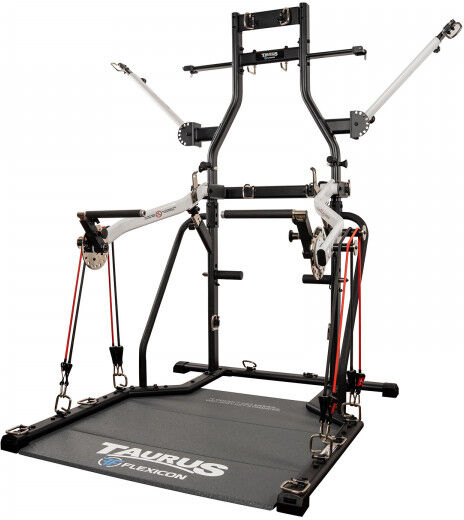
Taurus Flexicon Resistance TrainerUsing high-grade resistance bands to challenge your body, the Taurus Flexicon Resistance Trainer redefines how we approach strength training and resistance band training. The Resistance Trainer is a versatile platform powered by high-tension, patented resistance bands with carabiners to attach to...1349,10 £*Shipping: 0,00 £Secure redirect to the provider
-
What is the connection between physics, energy, and resistance?
Physics is the study of matter, energy, and the interactions between them. Energy is a fundamental concept in physics, as it is the ability to do work or cause change. Resistance, on the other hand, is a property of materials that impedes the flow of electrical current. In the context of physics, resistance is related to the energy dissipated as heat when a current flows through a material with resistance. This connection between physics, energy, and resistance is fundamental to understanding the behavior of electrical circuits and the transfer of energy in various systems. **
-
Why is there still resistance against geothermal energy here?
There is still resistance against geothermal energy in some places due to concerns about potential environmental impacts, such as the release of greenhouse gases and the potential for induced seismic activity. Additionally, there may be opposition from local communities who are concerned about the visual impact of geothermal power plants and the potential for noise pollution. There may also be economic factors at play, as some stakeholders may have vested interests in maintaining the status quo of fossil fuel energy production. Overall, addressing these concerns and educating the public about the benefits of geothermal energy will be important in overcoming resistance and increasing its adoption. **
-
What percentage of the power does a car consume to overcome rolling resistance and air resistance?
On average, a car consumes about 5-15% of its power to overcome rolling resistance and around 60-70% to overcome air resistance at highway speeds. This means that the majority of the power consumed by a car is used to overcome air resistance, which increases with speed. Rolling resistance, on the other hand, remains relatively constant regardless of speed. Therefore, efforts to improve aerodynamics and reduce air resistance can have a significant impact on a car's overall energy efficiency. **
-
What is the difference between resistance and specific resistance?
Resistance is the opposition to the flow of electric current in a material, measured in ohms. It is a property of the material itself. Specific resistance, also known as resistivity, is a material property that quantifies how strongly a material opposes the flow of electric current. It is a characteristic of the material's composition and is used to calculate the resistance of a specific shape and size of material. **
* All prices are inclusive of VAT and, if applicable, plus shipping costs. The offer information is based on the details provided by the respective shop and is updated through automated processes. Real-time updates do not occur, so deviations can occur in individual cases. ** Note: Parts of this content were created by AI.